David Morales is running for Mayor of Providence
SteveAhlquist.news · 2026-05-11 · Original source
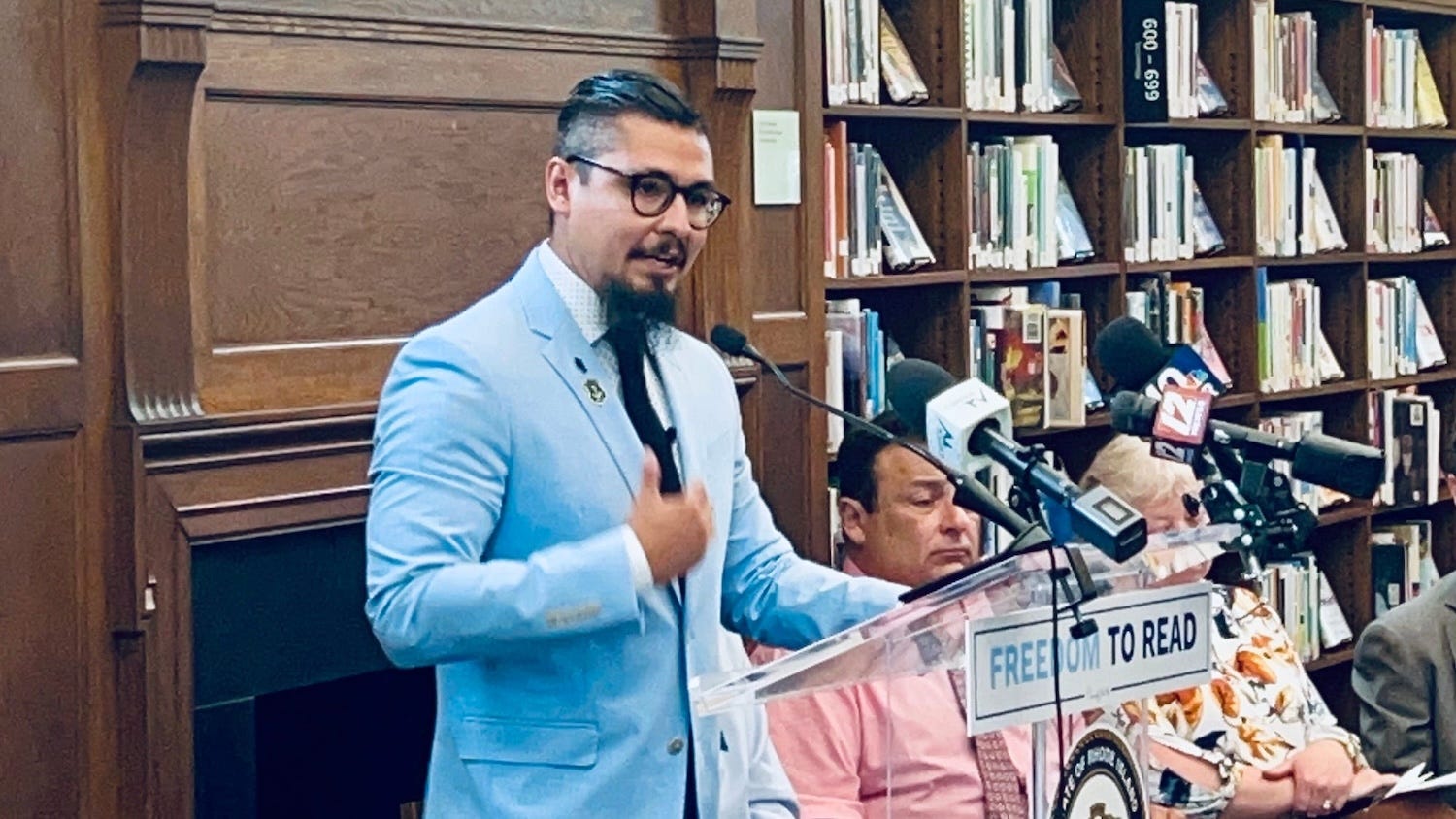
State Representative David Morales is running for Mayor of Providence against incumbent Brett Smiley. As a State Representative in the Rhode Island General Assembly, Morales has been a consistent progressive voice, working hard to pass legislation to ban rental application fees, raise the minimum wage, increase funding for Providence Public Schools, expand medical coverage to all children regardless of immigration status, ban payday lending, and lower prescription drug costs.
As a reporter who frequently covers the Rhode Island General Assembly, I’ve watched Representative Morales ask smart, probing questions in committee hearings. I’ve seen him on the House floor making bold progressive points during debates. I’ve also seen him outside the State House, not just when he’s running for office, but consistently, at community and political events.
I’ve also observed David in quieter moments, late at night when the State House is mostly empty, and a few committee meetings are running to midnight. I saw his frustration at the end of a legislative session a few years back as he learned that the legislation he had worked hard for would not pass. His sadness, anger, and determination in the face of that loss told me so much about who he is: He really, truly cares, and not for the political win, but for the positive impact his legislation would have on the lives of his constituents and all Rhode Islanders.
I’ve watched him with children, even when he’s not dressed as Spider-Man. He relates to them and shows them the same level of respect he would show to an accomplished adult. That’s why I’m endorsing David for Mayor of Providence. I’ve seen his heart, and it’s good. He’s the real deal, and he represents the kind of future I believe in and want for my grandchildren.
I sat down with David Morales on Friday morning outside New Harvest Coffee Roasters on Sims Avenue for the following interview:
Steve Ahlquist: Let’s start with an easy one: How many houses do you own?
David Morales: I own zero houses.
Steve Ahlquist: Zero?
David Morales: I’m proud to be a lifelong renter, and right now I’m renting on Academy Avenue with my girlfriend, Andrea, paying $1,900 a month. And of course, I have to mention our 19-pound cat, Mochi, who keeps us company there.
Steve Ahlquist: If elected, you’ll be the first mayor since Buddy Cianci to be a renter, who kept an apartment at the Biltmore, which, as I say it, seems a very different thing.
More seriously, why do you want to be the Mayor of Providence?
David Morales: Because our neighbors are currently suffering through a housing crisis, and there’s been a lack of action from the mayor’s office to address it.
I’m running for mayor because I grew up with a single immigrant mom and understand many of the challenges our working families across Providence face. Whether it’s the question of feeling comfortable sending their kids to our local public schools, or can afford to continue calling the state they love home. As mayor, I’m committed to working with the city council to cap annual rent hikes at 4%, to reimagine how we build housing in our city so there’s a stronger emphasis on affordability, and to have a budget that reflects the needs of our Providence public schools, which, more than anything else, is a reflection of staffing levels.
Steve Ahlquist: Providence is theoretically getting control of the schools back by the time the election’s over. What does Providence need to do to make the schools work better?
David Morales: We need to improve staffing levels across elementary, middle, and high school. I find it shameful that we have elementary schools with over 400 students, yet there’s only one counselor. We have high schools with over 900 students, yet there are only two social workers. There is something to be said about the lack of support that our students are receiving socially and emotionally, and to address that, we have to be willing to make the investments necessary so we have more frontline staff positions to support our students while at the same time recognizing that more often than not, our multilingual learners and our students on individualized education plans are falling short of the services that they deserve. Our administration will prioritize pathway programs to get more multilingual educators and special education teachers into our classrooms, because sustained staffing will lead to improved student experiences, greater family engagement, and, ultimately, academic progress.
Steve Ahlquist: I’m not multilingual, but it seems to me that having two languages should be an advantage, not a disadvantage. Why is it that our schools don’t see that it’s an advantage to be multilingual and proactively use that? They tried to teach me French in high school. It didn’t work, but they wanted me to be bilingual. Right now, we’ve got all these multilingual students, and somehow, it’s a problem? Why can’t we grab onto that?
David Morales: To your point, multilingualism is a strength, an asset that we have to fully leverage, and that’s going to require investment. Unfortunately, our multilingual learners have been overlooked, which is why we don’t have a pipeline of educators certified in bilingual and dual language education.
I applaud the efforts of Alfred Lima and Leviton Elementary Schools, as well as other elementary schools that are now adopting dual language classrooms. But the reality is that we need teachers who are adequately certified in these areas to make that a reality. That’s why our administration will be committed to establishing partnerships with Rhode Island College, CCRI, and the Rhode Island School of Progressive Education to subsidize pathways to certification in bilingual and dual language instruction. That way, we can have more teachers ready to meet our students’ needs. When we do that, we can design a K through 12 system, or at least a pathway program between an elementary, middle, and high school, that will be fully bilingual. We already have precedent with Leviton.
If we were to invest resources, perhaps Roger Williams Middle School could become the magnet school for bilingual education, and then we could have a high school; perhaps Alvarez High School could be transformed into a bilingual high school. That would give kids the opportunity to pursue a fully multilingual K-12 pathway.
Steve Ahlquist: Let’s talk about housing and the related issue of homelessness. What can the city do to expand housing in a way that’s more immediate than the 10 to 15 years it will take to build our way out?
David Morales: There’s so much our city can do to address the housing crisis and make sure our neighbors can afford to live in Providence. That starts with rent stabilization, ensuring our neighbors don’t have to endure the distress of watching their rent rise by more than 4% in a given year. I find it absolutely shameful that Mayor Smiley vetoed rent stabilization despite the city council’s best efforts.
I am committed, if the veto is not overturned, to work with the next delegation of the city council to make rent stabilization a reality in my first 100 days in office.
Steve Ahlquist: And beyond that?
David Morales: In addition, we have to be mindful of how we build moving forward. I believe very strongly that the city has a responsibility to begin the land acquisition process to build housing that will serve our lower-income neighbors, as well as working families who are struggling to find affordable rental units or homeownership opportunities. When we look at the vacant plots of land that you might find between Smith and Candace Street, on North Main Street, or in Elmwood, there is a lot of opportunity for the city to purchase that land directly and then partner with a nonprofit like SWAP (Stop Wasting Abandoned Property) to create accessible pathways for home ownership while at the same time building dense, affordable, publicly owned homes.
That is the pathway we need to work towards, but in the immediate, we need to stop the corporate takeover of our communities. We have watched Strive Realty and Amicus Properties buy up hundreds of homes across Elmhurst, Wanskuck, and Smith Hill. There needs to be accountability. Our administration will seek to impose a large transaction fee whenever any of these large real estate companies try to buy up additional homes in our communities. While federal law protects the rights of private ownership, and we cannot stop them from buying additional land or buildings, what we can at least do is make sure that the process is harder, and if they are to ultimately purchase more property, that there will be a benefit that goes back to our city.
Steve Ahlquist: One thing that no one has been able to explain to me is that, if we were to build more housing, what’s to stop a company like Strive from buying it all and imposing high rents? As long as they’re not using an algorithm, there’s nothing illegal about that.
David Morales: Exactly. And for that reason, we need a public developer model, in which the homes are publicly owned. We need to ensure that any new housing built in our city is designed to serve working people who already call Providence home.
Steve Ahlquist: There’s no real economic model I know of to make it profitable for a developer to build low- and no-income housing without government subsidies, so why shouldn’t the government build, own, and maintain these homes?
David Morales: And for that, we need a public developer model where the interest is not profit but making sure your neighbors are housed. Look at the waiting list for the Providence Housing Authority. They’ve had over 2000+ neighbors on that wait list for years and are struggling to access a home that would otherwise be restricted by income. In addition, under a public developer, they wouldn’t have to worry about their rent increasing as much each year.
Steve Ahlquist: Right now, people are suffering from extraordinarily high and rising rents in one of the worst housing markets in the entire country.
I was at the eviction of an encampment of people experiencing homelessness on Eudora Street yesterday. It’s a common thing in Providence. I understand that neighbors don’t necessarily want an encampment near their homes, for various reasons, but what is the alternative to what we’re doing now?
David Morales: The current administration’s attacks on our unhoused community have been absolutely cruel over the last several years. We’ve watched as our neighbors’ rights are violated. We’ve watched as our unhoused community members are essentially criminalized for being homeless, and a lot of our neighbors are unfortunately struggling with chronic homelessness that ties back to unmet mental health needs, substance use disorder, and alcoholism. We as a city need to be prepared to better support our neighbors in need by directly working with Amos House, Project Weber Renew, Mathewson Street Church, and Better Lives Rhode Island to guarantee case management services to allow our neighbors to have that sense of social and emotional support while at the same time offering a pathway towards transitional housing that doesn’t look like simply stuffing people into a crowded shelter. The reality is that many of our unhoused neighbors choose to be in encampments because they do not want to enter what has otherwise been an unsafe shelter system.
We need to work towards becoming a city that can acquire land for commercial and residential properties and transform them into transitional homes with wraparound case management services. When we’re able to make those types of investments, the alternative is a lot more dignified than cramming someone into a shelter system. We also need to recognize that we have the power to do this as a city because we ultimately control certain zoning and permitting procedures. The city can bypass permitting requirements to make emergency transitional housing readily available - and not just during the winter months, but year-round, because people’s lives are at risk every day spent outside.
Steve Ahlquist: Our current system says that if the temperature is above freezing, we’re not going to open emergency shelters, but you can die of exposure in 40-degree weather. It’s not hard to do, especially if you’re immunocompromised.
David Morales: Just living out on the streets is a risk to one’s life.
Steve Ahlquist: When you talk about wraparound services, are we talking about apartments, Echo Village, or a combination?
David Morales: I’m talking about case management services through a memorandum of understanding with organizations like Amos House, Project Weber Renew, Better Lives Rhode Island, etc., so that social services are readily available when these transitional housing units come online. When we have more transitional housing, we need to guarantee that it’s not just about having a roof over one’s head, but that there are actual case management services to go along with it. That is one of the initiatives that I certainly applaud as part of Echo Village: they were mindful to ensure wraparound services were readily available on site.
We would take a similar approach. Not necessarily expanding the Pallet Shelter infrastructure, but instead looking at existing buildings in our city that can be best utilized to ensure our neighbors have a place to call home and readily available services to support them with mental health and substance use issues. Our neighbors deserve the same level of dignity and services that the city is actively funding and supporting.
Steve Ahlquist: We know that the Housing First model works, despite what the Trump Administration is saying.
David Morales: Yes. Despite these evidence-based models working, they’re completely ignored.
Steve Ahlquist: It is disheartening.
David Morales: We have so many committed advocates who have been on the ground, working to ensure our unhoused neighbors are cared for. They have ideas on how we can best address this issue. I think of someone like Professor Eric Hirsch.
Steve Ahlquist: Sure.
David Morales: Professor Hirsch would certainly advise my administration as to how we address this growing crisis because when we have the actual advocates with lived experience or relationships with our unhoused community members, that’s going to best guide us as to how we make policy and budgetary decisions as opposed to the top-down model that we’re seeing now, where the focus is criminalization.
Steve Ahlquist: Some of the best people I know work in that space.
David Morales: And they deserve the opportunity to help guide policy and the decisions the city is making.
Steve Ahlquist: If elected mayor, you’ll be in charge of the police. What does that look like under your administration?
David Morales: Our administration will focus on restorative justice and ensuring greater emphasis on behavioral health. Unfortunately, what we have seen over recent years is that many of our unhoused community members, in particular, are being harassed by the Providence Police. Our approach would be to ensure that case management services are prioritized before armed law enforcement is involved. That’s why I made the earlier reference to the ways we would partner with Amos House, Mathewson Street Church, and other social service agencies that have rapport and relationships with our unhoused community members. We want to ensure that the Providence Police are a partner in that effort in cases where case managers feel their safety is being jeopardized.
As part of that, our administration will work toward appointing a public safety commissioner to oversee our fire and police departments and the Providence Emergency Management Agency (PEMA). When we have all of that in place, we will ensure a unified vision that emphasizes behavioral support and urgency when it comes to taking action around emergency crises, like what we saw this past February with the Blizzard, which I would argue was an emergency that required some level of strategy that went well beyond the Department of Public Works (DPW). A public safety commissioner will be able to share those priorities with our police department because they will be on the front lines, sharing information with the community and the press about what is happening on the ground.
We have seen incidents of violence in different parts of our city, from Providence Place Mall to to the East Side to parts of Olneyville, and elsewhere, and our neighbors deserve to have real time communication as to what’s happening on the ground, what the updates are, and what is being done to ensure that anyone who’s a victim of violent crime is receiving the support they need.
We’re also going to have a more intentional strategy around a public safety issue that is not talked about nearly enough, which is domestic violence. We’ve had a lot of families, in particular women of color, who are survivors of domestic violence, yet there are not many support services readily available when they call the police. We want to ensure that our responders are equipped with the resources needed to ensure that there are alternative forms of housing and that perpetrators are held accountable when it comes to domestic abuse.
Beyond that, further activating our substations. At this point, many questions remain about the role of these police substations. They’re not necessarily activated. They’re not welcoming environments. I believe that’s something as simple as signage that states their operating hours. A conversation with the local police officer can make a world of difference. That starts with relationship-building, and for too many, there’s been a disconnect.
Steve Ahlquist: Some of the stuff you mentioned is out there in a small way. You’re talking about ramping that up and expanding some of these policies and ideas?
David Morales: Absolutely. Again, we don’t have enough case management services going around on Cranston Street, for example.
Steve Ahlquist: In terms of domestic violence, you would have to ramp up Providence’s capacity to have a real impact.
David Morales: And that starts with empowering social service agencies like Sojourner House, which are on the ground already doing this work. Here in Providence, we are incredibly lucky to have so many nonprofit and social service agencies on the ground actively doing this work.
The issue has been that they have not received sufficient support at the city level to maximize the services they can offer. If we were able to enter a more formal partnership with Sojourner House, we could have access to more housing to ensure that any survivor of domestic violence has a safe and affordable home to go to as an alternative. We can ensure that there are more social workers and case managers as a part of that. This gets to a broader vision for how we would support our social service agencies. We will hire several grant writers to work with some of these direct social service agencies to help them secure more private, philanthropic, and federal funding.
Administrative capacity is tough for social service agencies that aren’t top-heavy, and it’s those agencies that are doing the most impactful work in our communities. If Project Weber Renew could tap into a city-level grant writer for support in formalizing an application, followed by a letter from the city demonstrating its support, they’re more likely to get that grant. And that’s the type of model we want to deploy from city hall: making sure that we’re using our tools and our resources to maximize the support our social service agencies can receive, because I recognize that our city budget of over $600 million has limitations.
Steve Ahlquist: Right now, when the police go to an encampment to evict, they hand out a piece of paper with contact numbers from various support groups. But sometimes the numbers are not useful because the partnership agreements do not cover all the services someone facing eviction might need, such as immediate rehousing. Empowering these orgs and aligning the list of services with reality would be very helpful.
The current mayor ran, in part, on being a capable, experienced administrator, and yet you’ve been calling him out on that. Can you talk to that and outline the ways you can be a better administrator?
David Morales: I’ve been concerned about some of Mayor Smiley’s department directors and his administration as a whole for their lack of urgency in addressing basic quality-of-life issues and budgeting practices. We’ve seen two tax increases over the last three years. The experience that Mayor Smiley has brought to the City of Providence has led to higher taxes and more dysfunction in basic city services. Our administration would prioritize expertise when, for instance, it comes to the Department of Public Works, where we would aspire to have a regional search for a director whose background is in traffic engineering, has perhaps worked in a city larger than Providence, and understands how to best navigate and manage a team that solely focuses on improving city services across the board while also emphasizing the importance of communication.
I believe that whenever we fill in potholes, for example, it should be done with a strategic approach, such as closing an entire street so we can address multiple potholes at once. We’re going to maximize use of our 311 system and send a 311 text exclusively to neighbors in the area, letting them know their street will be closed for several hours while we make these critical repairs.
There’s a gap between the administration and how our neighbors on the ground are feeling, so we’ll prioritize expertise across all departments. We’re going to ensure that when it comes to the Department of Recreation, for example, we are going to have a committed community member who has decades of experience being here in our city, working with youth sports, working with our schools, and is going to be able to bridge that gap where right now, there is unfortunately not enough partnership. These are the ways to build a team that is ready to hit the ground running and, most importantly, start delivering the excellent city services our neighbors deserve.
We’re going to take a more thoughtful approach to building a city budget that raises revenue without overreliance on residential property taxes. We can reform how we address commercial property taxes because last year, the General Assembly passed a law allowing the City of Providence to adopt a two-tier commercial tax system. As mayor, I would work with the tax administrator to introduce a city budget with higher commercial tax rates for industrial facilities operating near the Port of Providence. That allows us to hold those corporate polluters accountable while raising more revenue for our city. We’re going to hold absentee landlords accountable by directing the Department of Inspections and Standards to stop being so lenient and to issue fines and penalties when major code violations put tenants’ lives at risk.
Steve Ahlquist: That would require hiring more people to conduct those code-violation inspections.
David Morales: To an extent, it would require more hiring, but it would also require the direction of the executive branch. Unfortunately, I have had internal conversations with certain members who work for the city in different departments, and there is a lack of urgency from the administration when it comes to something as basic as issuing fines for code violations or reimagining a more proactive and communicative model from DPW.
Steve Ahlquist: I don’t understand why, in a city starved for money, they won’t go to an unshoveled absentee landlord’s property and issue fines.
David Morales: Or why we won’t apply the vacancy tax to certain commercial structures that have been vacant, and are still paying the traditional property tax rate. There is a lack of accountability.
Steve Ahlquist: You think that would be an automatic function. We have computers now.
David Morales: Exactly. One of the administration’s shortcomings is a lack of accountability. They have not done enough to hold vacant property owners accountable, including absentee landlords who aren’t doing their part to keep our neighbors safe. As a result, not only are we harming our city as a whole, but we’re also putting our neighbors at risk.
Steve Ahlquist: When you’re going around the city, what are you hearing from people as to what their priorities and thoughts are?
David Morales: A lot of neighbors are worried about whether they can afford to live in Providence.
Steve Ahlquist: That’s the big one. What else?
David Morales: There’s a lot of frustration around city services because four years ago, the current mayor ran on having the best-run city in America, and the reality has been that city services have been depleted, and many families are concerned about the lack of planning for transitioning the schools back to local control. I’ve heard from many community members who feel that City Hall is not actively working for them or prioritizing their needs, including housing, public schools, city services, and the protection of our immigrant community. I’ve spoken to a lot of neighbors who tell me that they’re terrified on behalf of our immigrant neighbors because they feel silence or performative press conferences are coming out of City Hall, as opposed to actually addressing ongoing issues and cases where you have community members being tackled and detained outside of the courthouse downtown.
Steve Ahlquist: Let’s talk Port of Providence. The South Providence and Washington Park neighborhoods are working hard to change the direction of the Port and maybe reduce the health risks associated with living there, where some of the highest asthma rates in the country are found. I also hear there is some discussion of bringing more unhealthy, toxic industries there.
David Morales: For decades, our neighbors have experienced constant air pollution from the Port of Providence, combined with scrap yard fires that harm the health of so many children, young people, families, and elders. If you live in South Providence, you are breathing in contaminated air. It is one of the most polluted zip codes in the entire country. For that reason, we need a comprehensive approach that may require forms of eminent domain. Let’s purchase the Rhode Island Recycled Metals property. Rhode Island Recycled Metals has not been held accountable for scrapyard fires. Our administration would seek to acquire land around the Port of Providence, excluding parts of ProvPort where we have that ongoing contract. But for the private land, we should start purchasing it, think through how we can pursue brownfield mediation, and, most importantly, how we can create recreation opportunities. I find it shameful that Public Street, one of the few shoreline access points around the Port of Providence, is not a very welcoming environment.
Steve Ahlquist: It’s a little bit scary.
David Morales: The conditions are not designed for neighbors to enjoy the shoreline.
Steve Ahlquist: Despite that, neighbors are still occasionally holding little festivals and events there. It’s such a resilient and amazing community.
David Morales: Building community despite the city’s lack of effort.
Our administration would work directly with the People’s Port Authority, the Racial & Environmental Justice Committee, and Save The Bay to collectively reimagine how the Port could better serve our neighbors without turning it into an industrial wasteland that pollutes our environment.
Steve Ahlquist: Waterson Terminal Services is also interested in expanding and purchasing land adjacent to or in the Port. Recent actions by the Trump Administration are delaying wind energy development, which is a key part of identifying cleaner industries for the Port. There’s talk now of maybe moving backward on some of the commitments we’ve made to wind energy, into fossil fuels, nuclear, and Blue Economy industries (which includes military contractors). What are your thoughts on that?
David Morales: We certainly have to invest in renewable energy at the local level. This is the role of state and local government. When the federal government is attempting to go backward, as they have on so many issues, it is the responsibility of local and state governments to have backbone on these issues, and that requires investment and commitment. We should work towards a green infrastructure bond to help us develop more renewable energy infrastructure and address ongoing environmental concerns across our city. Right now, there is a disproportionate amount of flooding that happens across Valley, Onlyville, and the north end. We need to pass a green energy bond that invests in renewable energy while also upgrading our outdated sewage system. When we take those steps, we can reduce flooding risks and, in the future, save lives by preventing homes from being destroyed by excessive flooding.
Steve Ahlquist: Mayor Smiley recently referred to parts of South Providence as the “Nightclub District,” much to the chagrin of some members of the South Providence and Washington Park Neighborhood Associations. What are your thoughts?
David Morales: For starters, South Providence has been constantly disrespected. There’s been constant disrespect stemming from a lack of engagement between City Hall and our neighbors on planning and development. Permits are pulled without any communication or engagement with our neighbors. You wouldn’t see that in different parts of the city.
Steve Ahlquist: Oh no. I live on the East Side. It simply couldn’t happen there, unless a landlord wants to knock down a historic building.
David Morales: When it comes to South Province, it’s a rubber stamp. Our administration commits to engaging in dialogue with our neighbors across the city, especially in South Providence. We would host regular community meetings and be fully transparent about which permits are going before the city planning commission. We would ensure that our neighbors are aware of how they can participate in the process to either oppose or support the issuance of a permit. Right now, the nightclub district has been established without any form of communication.
Steve Ahlquist: I’d never heard the term until Mayor Smiley said it.
David Morales: It’s incredibly concerning because we have families who are proud to call South Providence and Washington Park Home, but they hear this constant disrespect. They feel disengaged and ask themselves, “Why do we want to continue living in a city that constantly disrespects us?”
Steve Ahlquist: You have a plan for getting elected, I’m sure, but as far as I know, winning the East Side is a big part of becoming Mayor of Providence. What are your thoughts on winning the East Side?
David Morales: Many of our neighbors on the East Side share the same concerns as our neighbors between the North End and South Providence. They’re concerned about the quality of our public schools. They’re concerned about whether their neighbors can continue calling Providence home. Our message is consistent, regardless of where we are in the city. We focus on affordability, improving the quality of our public schools, and guaranteeing the safety of our immigrant community. We’ve built up a lot of momentum across the city, especially on the East Side, where there has been a very strong sense of buyer’s remorse. Many neighbors are disappointed with what they’ve seen from the current administration, despite initially supporting the mayor when he ran a few years back.
As part of that, we’ve persuaded many neighbors to join our movement. What we have built is a grassroots campaign with over 1,000 volunteers. We have built a grassroots campaign that has raised over $300,000 from more than 2,500 unique individuals. That speaks volumes as to the movement we’re building in our city, and that’s what we’re working towards between now and beyond September because we want to create a culture within Providence where your government is encouraging you to be civically engaged, not just during election season, but as decisions are actively being made. Right now, many of our neighbors on the East Side feel disconnected from City Hall.
Steve Ahlquist: Let’s talk about immigration enforcement and protecting Providence residents.
David Morales: I’ve been incredibly frustrated by the lack of urgency that has come out of City Hall to address ICE’s growing operation across Providence. We’ve seen them show up in the West End, Onlyville, Smith Hill, outside the courthouse in downtown, and in front of our local schools like Hope High School. Rather than holding performative press conferences or issuing executive orders that merely solidify existing law, our administration will focus on action. We’re going to make sure that those fascist ICE agents who are coming in and terrorizing our communities are held accountable.
We have so many advocates who have been on the ground over the last year and a half working to protect our immigrant community. The Deportation Defense Line (401‑675‑1414) deserves a partner at City Hall. If they gather evidence that ICE has violated our sanctuary city laws or our neighbors’ rights, we need to ensure our city solicitor’s office is prepared to work with them to develop a case that we can refer to the Attorney General’s office for prosecution. We’re going to hold these fascist ICE agents accountable. We’re going to make it very clear that if and when they come into our city, they will face legal enforcement against their unchecked abuse.
Steve Ahlquist: Is there more our city can do to protect the rights of our trans siblings?
David Morales: There’s so much more our city can do to protect our trans community. It starts with making sure that our young people feel supported. Right now, we have a lot of trans youth who, unfortunately, are being bullied at school and facing verbal abuse at home. For that reason, we, as a city, need to have a stronger agreement with Youth Pride Inc. in place to ensure greater representation and services at our elementary, middle, and high schools. We need to make sure our youth know there are trusted adults and community members who care for them and will be there to provide that service. We also have a disturbing trend where many of our trans people are finding themselves homeless. They’re being kicked out of their homes as early as age 14.
Steve Ahlquist: Could we work with Haus of Codec to ensure enough beds for queer youth in need?
David Morales: We should certainly be financing Haus of Codec. This goes back to the longer conversation we had about land acquisition. If the city owned multiple multifamily properties, they could be either leased or gifted to the Haus of Codec at a discounted rate to ensure the Haus has increased capacity, because they have literally saved the lives of over a hundred queer young people who would otherwise find themselves on the streets.
Steve Ahlquist: When you’re out there in the world, and you meet somebody who doesn’t really know much about anything, how do you persuade them to vote for you? What is your pitch?
David Morales: My pitch is that Providence can be much more affordable. We can have a high-quality public school system for our kids, and we can guarantee that all our neighbors feel safe, regardless of immigration status. I then explain how the city has the tools to cap annual rent hikes. We have the tools to build more affordable homes, and we have the resources to better support the quality of education our students receive. My pitch is that the city government can do so much more than what we are doing now. The status quo has left so many of our neighbors behind and disconnected from the government.
The movement we’re building is centered on excellence in government, ensuring our neighbors can continue to call Providence home because they can afford to live here, have parents who feel proud to send their kids to our public schools, and have a community where our immigrant neighbors feel safe and protected. That’s the Providence we aspire to, and that’s the Providence that we can make a reality.
Steve Ahlquist: Thank you so much.